AI History POV Videos
The Time Travel Trend Taking Over TikTok
AI history POV videos are short, first-person vlogs where an AI-generated time traveler films selfie-style clips inside a historical moment — the Black Plague, ancient Rome, Chernobyl in 1986 — and talks to camera as if you were there. The format exploded on TikTok in early 2025, and single videos now clear 20 million views. This is the full story: who started it, why it works, the accuracy backlash, and how the videos actually get made.
Watch: How to Make an AI Time Travel Vlog

What Are AI History POV Videos?
An AI history POV video puts a fictional narrator inside a real historical event and films it like a modern vlog. The character holds the camera at arm's length, selfie-style, and reacts in first person: "So I'm literally standing in London in 1351 and everyone around me is sick." A bold caption on screen sets the scene — "POV: You Wake Up During the Black Plague" — and word-synced subtitles carry the narration.
The videos are usually 30 to 60 seconds long and vertical. What makes them land is the collision of two worlds: smartphone vlog language — shaky framing, direct address, casual narration — dropped into places no camera ever existed. Your brain knows it's impossible, and that's exactly why you stop scrolling.
The anatomy is remarkably consistent from account to account: a title banner that doubles as the thumbnail, a spoken hook in the first three seconds ("So I'm literally in..."), a mid-video escalation as the era turns dangerous, and an ending that cuts on a cliffhanger or a punchline. Word-synced captions carry viewers who watch with sound off, and the whole video is built from four to eight short talking selfie clips stitched together.
The format goes by several names — the AI time traveler trend, the "POV: you wake up in" trend, the time travel vlog trend, history POV TikTok — but they all describe the same thing. And unlike most AI video fads, this one has kept growing for over a year, spawning spin-offs, full-time AI influencers, national press coverage, and a genuine backlash from historians. If you want the tool side of the story, our AI time travel video generator guide covers how a finished vlog gets made in one app.
Who Started the AI Time Traveler Trend? The Complete Timeline
Press coverage keeps writing about the trend, but nobody tells the whole story with dates and numbers. Here it is.
Late January 2025 — The first AI historical vlogs
TikTok account @timetravellerpov starts posting AI-generated "vlogs" from Pompeii in 79 CE, 1800s London, and the Industrial Revolution, as documented by The Post. The clips look like found footage from centuries before cameras — and they immediately start spreading.
Mid-February 2025 — The POV pivot
The account switches to the pure POV format with "POV: You Wake Up in The Prehistoric Era" and growth accelerates past 500,000 followers. Within roughly 30 days, copycat accounts — The_POV_Lab, SalvagedHistoryAI, Histairy_Films, ImpossibleAICinema — each gain 100,000 to 800,000 followers of their own.
Spring 2025 — The mega-viral numbers
@timetravellerpov's "POV: You Wake Up as a Chernobyl worker in 1986" passes 21.8 million views and nearly 2 million likes, and "POV: You Wake Up in 1351 During the Black Plague" clears 19.5 million views, per Dexerto's reporting. The most-watched plague POV video across all accounts hits 53 million views.
Individual eras prove their own pull: a "POV: You wake up as a Pyramid Builder" video hits 2.5 million likes, a "kid in ancient Egypt" POV hits 1.3 million, and Black Plague POVs collect 4.4 million likes on a single video.
May 2025 — The spin-off wave
The selfie-vlog formula escapes history entirely. On May 25, 2025, @bigfootvlogs posts the first AI Bigfoot vlog, pulling 6.3 million plays and 675,000 likes in three weeks. Lighter time-travel spins appear too — "a 2000s kid," "mermaid princess" — proving the format works beyond disaster content.
February 2026 — The AI history influencer era
Chloe VS History launches: a fully AI-generated "time traveling history influencer" who reaches roughly a million cross-platform followers from about 21 videos. Her most-viewed video — trying to warn Titanic passengers — hits 4.3 million views, and the account draws coverage from BBC News, Sky News, Fox News, and the Washington Post before Sky unmasks UK creator Jonathan Laramy in May 2026. We break down her whole format in how to make videos like Chloe VS History.
Why Are AI Time Travel Videos So Popular?
The trend isn't luck. Four mechanics stack on top of each other.
Extreme visual contrast
A person holding a phone in a plague-ridden medieval street is a walking contradiction. The impossible pairing is the hook — viewers stop because the frame itself doesn't make sense, then stay to see how the era plays out.
Selfie framing is the platform's native language
TikTok trained a billion people to trust the front camera. A history documentary feels like homework; a selfie clip from 1351 feels like a FaceTime call from a friend who happens to be dying of plague. The POV caption completes the trick by casting the viewer as the character.
Education-entertainment keeps people to the end
History content averages a 72% completion rate on TikTok versus 54% for general entertainment. Viewers feel like they're learning something while being entertained, and completion rate is exactly the signal short-video algorithms boost hardest.
The creator never shows their face
Every star of this trend is AI-generated, which makes it one of the most accessible faceless content formats ever. Anyone with a laptop can run a history POV account anonymously — and the faceless history channel economics are real: TikTok's Creator Rewards pays roughly $0.40 to $1.00 per 1,000 qualified views on 60-second-plus videos, with education-adjacent niches at the top of that range.

Are AI History Videos Accurate? Inside the Historian Backlash
Short answer: frequently not, and the pushback is now part of the trend's story. In May 2026, historian Jo Teeuwisse — better known as Fake History Hunter — published a detailed accuracy review of Chloe VS History, flagging errors like Tudor London depicted with uniformly filthy, waste-filled streets, a Hollywood myth that real historians have spent years debunking.
She wasn't alone. Dr Amy Boyington called one viral medieval video "amateurish," pointing to glazed windows in peasant homes and a train track running through a landscape centuries before railways existed. The criticism cuts both ways: it shows millions of people are absorbing history from these clips, and it shows most creators aren't checking their eras.
That's actually an opening. Comment sections on history POV TikTok are full of viewers who love catching anachronisms — get the details right and the same crowd becomes your defense force. Here's a good-faith checklist no other guide publishes:
The AI History Accuracy Checklist
- Date-stamp your scenario, then check what existed. Glass windows, forks, potatoes in Europe, printed books — each has a start date. If your video says 1351, everything in frame should too.
- Watch for transport and infrastructure anachronisms. Train tracks, paved modern roads, and streetlights are the mistakes historians called out by name.
- Don't recycle Hollywood myths. Medieval streets were not uniformly filthy, gladiators rarely fought to the death, and pyramid workers were paid laborers — the comments will remind you.
- Match clothing to class and century. A peasant in dyed velvet is as wrong as a smartphone. Rough linen and wool read as authentic and film beautifully.
- Label your content as AI-generated. Platforms increasingly require disclosure for synthetic media, and audiences reward creators who are upfront about it.
The Hashtags Viral History POV Videos Actually Use
Pull up any of the biggest videos in the trend and the same tag pattern repeats: a few broad discovery tags plus one or two era tags. This is the working set from real viral history POV TikTok videos:
Swap the era tag to match your video — Rome and Pompeii videos use #rome and #pompeii, plague content leans on #medieval and #blackdeath. If you're still deciding which era to cover, our list of 50 time travel vlog ideas ranks eras by proven demand.
How Do People Make AI History POV Videos?
Two very different answers: the way the trend started, and the way it works now.
The original multi-app grind
- ✗Write and refine a script in a chat assistant
- ✗Generate character stills in a separate image tool
- ✗Animate each still in a video animator, clip by clip
- ✗Record narration in a separate voice tool
- ✗Assemble clips, sync audio, and caption everything in an editor
Fast Company reported that each @timetravellerpov video takes around four hours with this workflow — and keeping the character's face consistent across clips is the hardest part.
The one-app pipeline
- AI writes a hook-first script from your era idea
- 4-8 talking selfie clips with a real voice performance
- Face and outfit stay consistent in every clip, automatically
- Word-synced captions and a title banner built in
- One vertical 9:16 video, stitched and rendered in minutes
No prompt engineering, no model picking, no editor. That's the whole pitch of a purpose-built AI time travel video generator.
Pick who's traveling
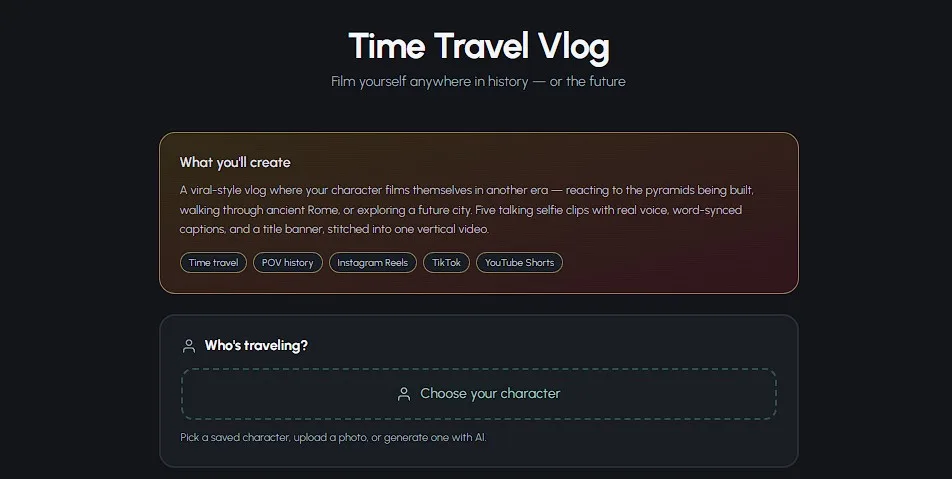
Choose a saved character from your library, upload a photo to put yourself in history, or generate a brand-new character with AI. Whoever you pick keeps the same face and outfit across every single clip — the exact consistency problem that eats hours in the multi-app workflow.
Type where and when
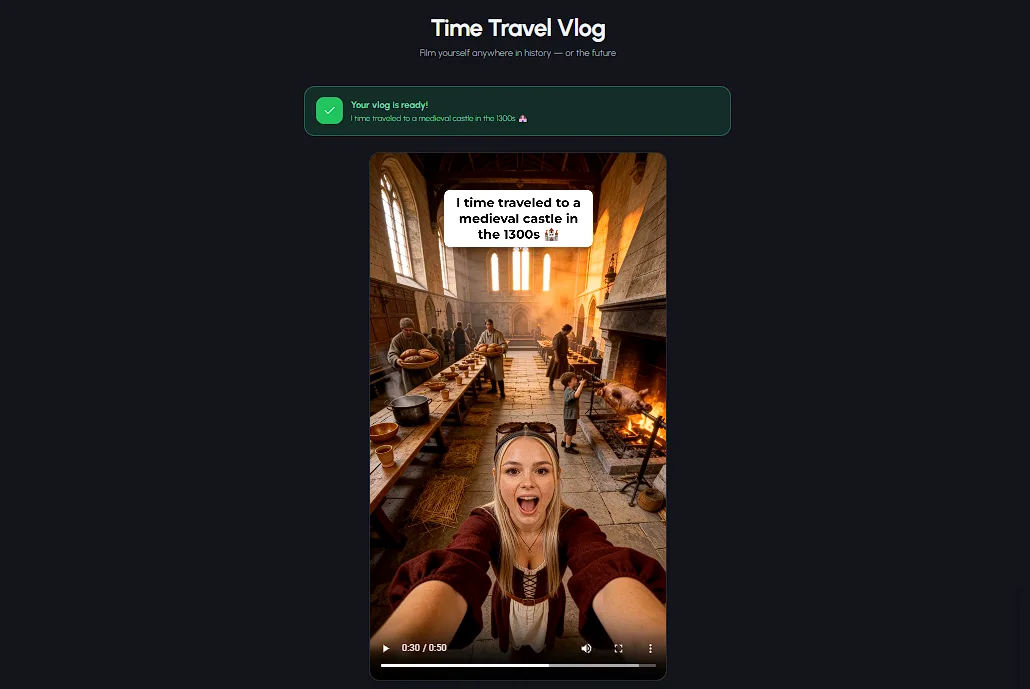
Describe any destination in plain text — "Ancient Egypt while the pyramids were built" — or tap a preset like Rome 50 BC, a medieval castle in the 1300s, the Ice Age, the dinosaur era, or a city in the year 3000. Any era works, real or imagined.

Pick quality, set clips, create
Choose a quality tier, set 4 to 8 clips, and click Create My Vlog. AI writes the script, generates every talking selfie clip, and stitches them into one vertical video with a title banner — encoding usually takes 1 to 3 minutes. An 8-clip vlog also clears TikTok's 60-second minimum for Creator Rewards, which only pays on longer videos.
Want the full deep-dive with scripts, hooks, and posting checklists? Read how to make time travel vlogs with AI.

Frequently Asked Questions
Everything people ask about AI history POV videos and the time travel trend
What is the 'POV: you wake up in' AI trend?
It's a viral video format where an AI-generated 'time traveler' films selfie-style vlog clips inside a historical moment — the Black Plague, ancient Rome, Chernobyl in 1986 — and talks to the camera as if you were there. Videos open with a caption like 'POV: You Wake Up in 1351' and follow the character reacting to the era in first person. The format started on TikTok in early 2025 and has since spread to YouTube Shorts and Instagram Reels.
Why are AI time travel videos so popular?
Three things stack together: the extreme visual contrast of a modern-looking person inside a plague street or a Roman arena, the selfie framing that makes it feel like a FaceTime call from another century, and the education-entertainment blend that keeps people watching to the end. History content averages a 72% completion rate on TikTok versus 54% for general entertainment, which the algorithm rewards heavily.
Are AI history videos historically accurate?
Often not, and historians have publicly called this out. Jo Teeuwisse (Fake History Hunter) published a critical accuracy review of the biggest AI history account in May 2026, and Dr Amy Boyington called one viral medieval video 'amateurish' for showing glazed windows in peasant homes and a train track centuries before railways existed. Treat these videos as entertainment first — and if you make your own, fact-check the era details before you publish.
Who started the AI time traveler trend on TikTok?
The TikTok account @timetravellerpov is widely credited as the originator. It began posting AI-generated historical vlogs in late January 2025, switched to the pure 'POV: You Wake Up in...' format in mid-February 2025, and grew past 500,000 followers. Copycat accounts gained 100,000 to 800,000 followers each within about 30 days, and a second wave of AI history influencers like Chloe VS History followed in 2026.
What hashtags should I use for AI history and time travel videos?
Viral history POV videos consistently pair broad tags with era-specific ones. The core set is #history, #historytok, #pov, #ai, and #fyp, plus a tag for your era such as #egypt, #rome, #medieval, or #timetravel. Many top videos also add #cinematic to signal production quality. Two or three broad tags plus one or two era tags is the pattern that keeps showing up on the biggest videos.
What is the AI Bigfoot vlog trend and is it related to time travel vlogs?
Yes — it's part of the same AI selfie-vlog wave. On May 25, 2025, the account @bigfootvlogs posted the first cryptid selfie vlog, which gained over 6.3 million plays and 675,000 likes in three weeks. It uses the exact same formula as history POV videos — a consistent character filming handheld selfie clips in an impossible setting — just with a monster instead of a time traveler.