Ancient Rome AI Video
Gladiator & Pompeii POV Vlogs That Go Viral
Wake up in the gladiator barracks, on a Pompeii street the morning Vesuvius blows, or behind a market stall in Rome, 50 BC. One app turns any Roman scenario into a finished selfie-style vlog — consistent character, real voice, word-synced captions — in minutes.
Watch: How to Make an AI Time Travel Vlog
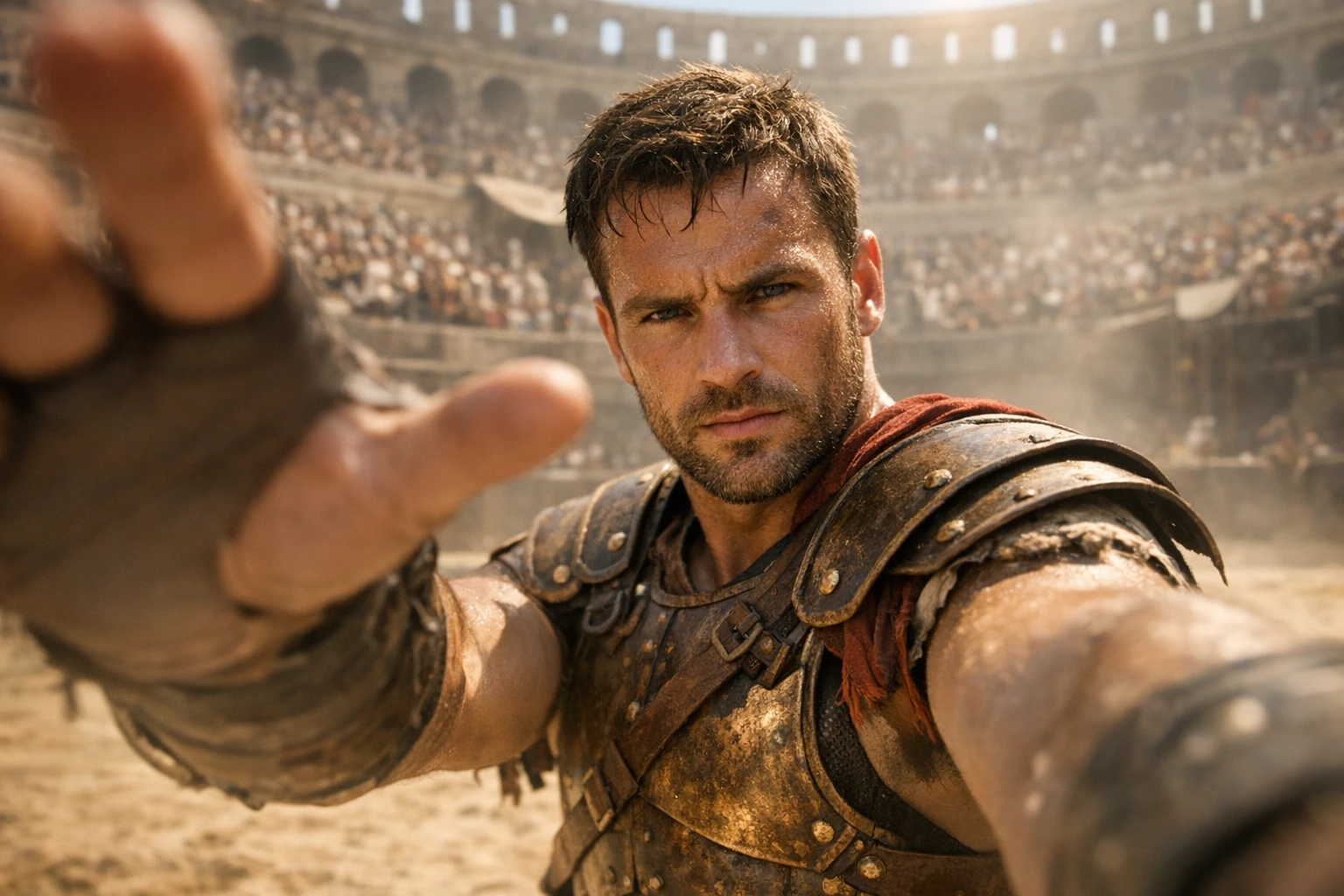
What Is an Ancient Rome AI Video?
An ancient Rome AI video is a first-person, selfie-style vlog starring a character who "wakes up" somewhere in the Roman world — the gladiator barracks, a Pompeii street in 79 AD, the Forum at rush hour — and films it like a modern creator would. The character talks straight to camera, reacts to the era around them, and carries you clip to clip through one short story. It is the Roman branch of the POV time travel trend, and it is one of the format's proven heavy hitters.
The receipts are public. The account that kicked off the trend, @timetravellerpov, counts gladiatorial Rome and Pompeii among its flagship eras alongside videos like its Chernobyl POV that passed 21.8 million views. Fast Company named the Vesuvius eruption one of the format's signature scenarios — while also reporting that each of those videos takes around four hours to make with a multi-tool workflow. And a creator-economy analysis of the trend's winning formula lists Pompeii 79 AD and Roman gladiators right next to the Black Death and the Titanic as the eras that reliably perform.
In other words: Rome works. Pompeii even has its own TikTok trend page, and "POV: you wake up in ancient Rome AI video" is a phrase people literally type into search bars. What has been missing is a simple way to make one — because until recently, every tutorial for this trend meant juggling four or five separate apps.
That is the gap an AI time travel video generator closes. You type where and when, and one pipeline handles the script, the talking selfie clips, the voice, the captions, and the final vertical edit. No prompt engineering, no model picking, no timeline software. This guide covers the three Roman formats that go viral, ready-to-use scenarios, a sample Pompeii script, accuracy notes viewers actually care about, and the three-step walkthrough to make yours today.
The 5-App Workflow vs One Click
Every tutorial for this trend teaches the hard way. Here is the difference.
The DIY Multi-App Way
- ✗Write prompts in a chat assistant, then generate stills in a separate image tool
- ✗Animate each still in a video animator, one clip at a time
- ✗Generate narration in a voice tool and hope it fits the footage
- ✗Assemble everything and hand-time captions in an editor
- ✗Watch your gladiator's face change between clips — the #1 complaint in this niche
With AutoClips Time Travel Vlog
- Type "Rome, 50 BC" or any scenario — the AI writes a hook-first script
- 4-8 talking selfie clips generated with a real voice performance
- Same face, same armor, every clip — consistency is automatic
- Word-synced captions, title banner, and 9:16 vertical stitching built in
- Encoding usually takes 1-3 minutes — post the same hour you had the idea
POV: You Wake Up as a Gladiator
The arena is ancient Rome's proven hook, and the roman gladiator AI video is the era's flagship format. A gladiator POV was one of the videos that defined the trend in its first weeks, and it is easy to see why: the stakes are built in. Your character is not sightseeing — they might die this afternoon, and the audience knows it from the first frame.
The strongest gladiator vlogs lean into the hours before the fight rather than the fight itself. Waking up in the barracks, the last meal, the sound of the crowd getting louder through the tunnel — that slow build keeps viewers through all 4-8 clips, which is exactly what the algorithm rewards.
Gladiator scenarios that work:
- "POV: You wake up as a gladiator on the morning of your last fight — Rome, 80 AD"
- "POV: You're the lanista's newest recruit and training starts at dawn"
- "POV: You're a woman in the Colosseum crowd at the inaugural games"
- "POV: You're the medicus stitching up fighters behind the arena gate"
- "POV: You wake up as a retiarius — and your opponent is your best friend"
Type any of these into the era box as-is. The AI treats your scenario as the story brief and writes the script around it, so the more specific the role and the date, the sharper the vlog.
POV: You Wake Up in Pompeii — August 24, 79 AD
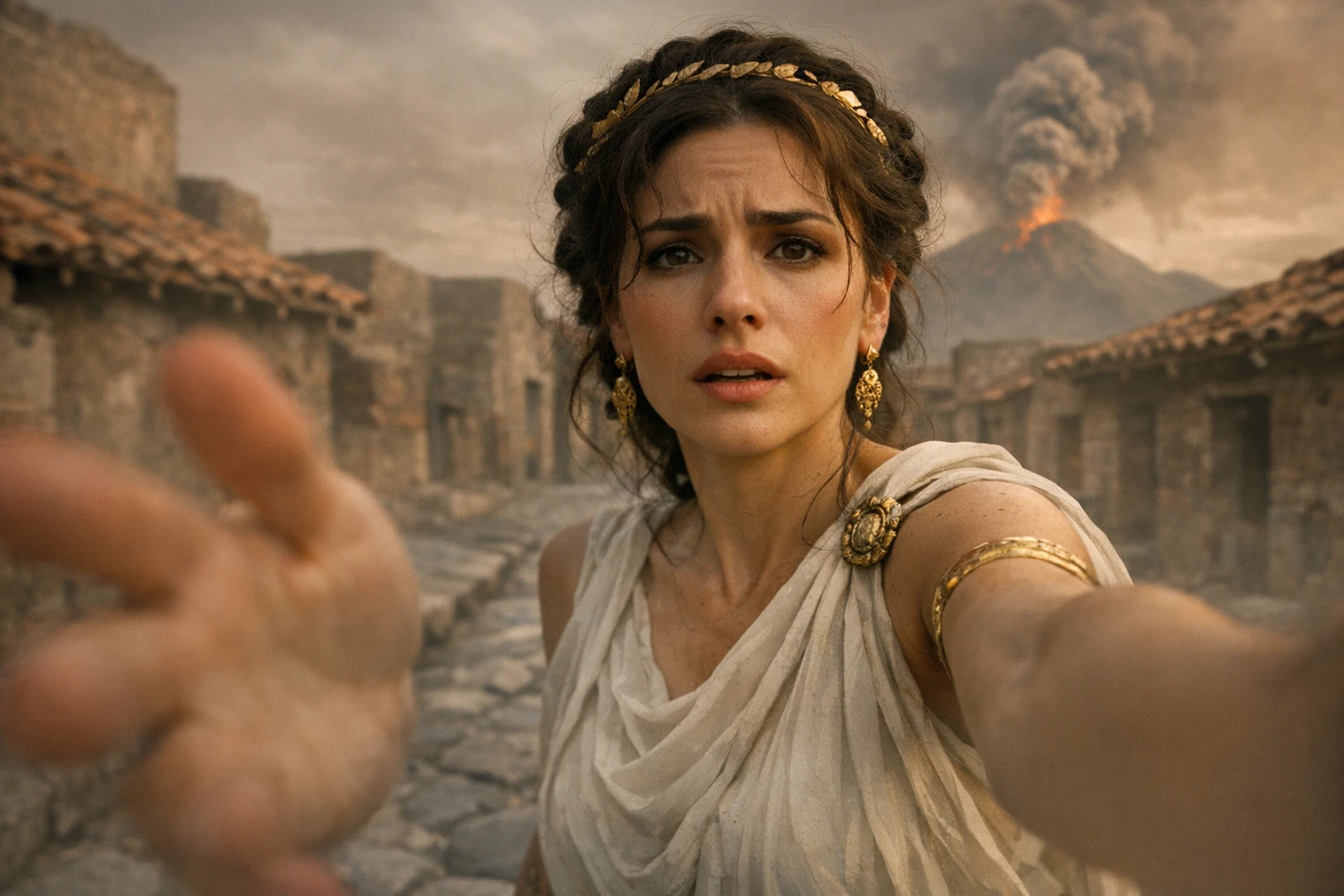
The "POV: you wake up in Pompeii" AI video is the date-stamped disaster format at its purest, and it is the Roman scenario with the most mainstream heat. Pompeii has its own TikTok trend page, and when the Washington Post profiled the AI history influencer wave, a Pompeii video was one of the examples cited. Viewers know exactly what is coming — the tension is that your character does not.
The narrative engine here is the try-to-warn-them-and-fail arc — the same structure behind the trend's biggest disaster videos, from the Titanic to the Black Plague. Your character is the only one who knows what the mountain is about to do. They warn the baker. They beg the merchant. Nobody listens. The vlog ends with the cloud coming down the slope and a cliffhanger for the next era.
One craft note: real Pompeii gave creators a perfect three-act timeline. The morning was ordinary. Around midday the column rose and ash began to fall like grey snow. The deadly pyroclastic surges came hours later. Map your clips onto that progression — normal, wrong, catastrophic — and the pacing takes care of itself.
Pompeii scenarios that work:
- "POV: You wake up in Pompeii on August 24, 79 AD — and you're the only one who knows"
- "POV: You're a baker in Pompeii and the ovens won't stop trembling"
- "POV: You try to warn the whole forum and everyone laughs"
- "POV: You're on a fishing boat in the Bay of Naples watching the column rise"
Daily Life in Rome, 50 BC: The Evergreen Ancient Rome POV Video
Not every ancient Rome vlog needs a disaster. The daily-life ancient Rome POV video — an ordinary person narrating an ordinary day in 50 BC — is the format that builds subscribers rather than one-off spikes. Viewers come back for the next "day in the life" the way they return to a favorite travel vlogger.
This one maps directly onto a built-in preset: "Rome, 50 BC" is one of the era chips inside the Time Travel Vlog, so it is literally a one-tap destination. Caesar is in Gaul, the Republic is wobbling, and the Forum is the loudest place on Earth — plenty of texture for a talking selfie vlog without a single sword being drawn.
Daily-life scenarios that work:
- "POV: You wake up as a forum merchant in Rome, 50 BC"
- "POV: You're a legionary on the frontier writing home"
- "POV: You're a senator's slave who hears everything"
- "POV: You're a street cook selling hot chickpeas outside the baths"
If Rome is your entry point but you want a whole channel, rotate eras: pair this post's scenarios with a medieval AI video week and an Ancient Egypt AI video week, or pull from a bank of 50 time travel vlog ideas spanning the Ice Age to the year 3000.
How to Make an Ancient Rome AI Video in 3 Steps
From idea to finished gladiator vlog in minutes — no editing, no juggling apps
Pick Who's Traveling to Rome
Choose a saved character from My Characters, upload a photo to put yourself in ancient Rome, or generate a brand-new character with AI. Whoever you pick, their face and outfit stay consistent across every clip automatically — the exact thing multi-app workflows can't guarantee.
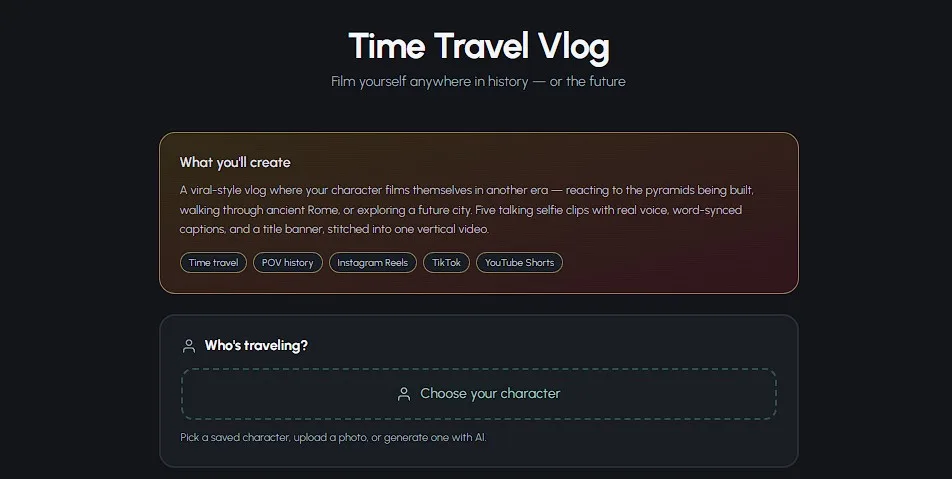
Type Your Roman Destination
Tap the "Rome, 50 BC" preset chip, or type any scenario from this page into the free-text box: "Pompeii on August 24, 79 AD", "the gladiator barracks in Rome, 80 AD" — any era works, and the more specific your role and date, the better the script.

Pick Quality, Set Clips, Create
Choose Pro Max for the most cinematic motion (10-second clips), Pro for the sharpest lip-sync (8-second clips), or Lite for quick drafts. Set 4-8 clips and click Create My Vlog. The AI writes a hook-first script, generates every talking selfie clip, and stitches them into one vertical 9:16 video with word-synced captions and a title banner like "I time traveled to Pompeii in 79 AD". Encoding usually takes 1-3 minutes.
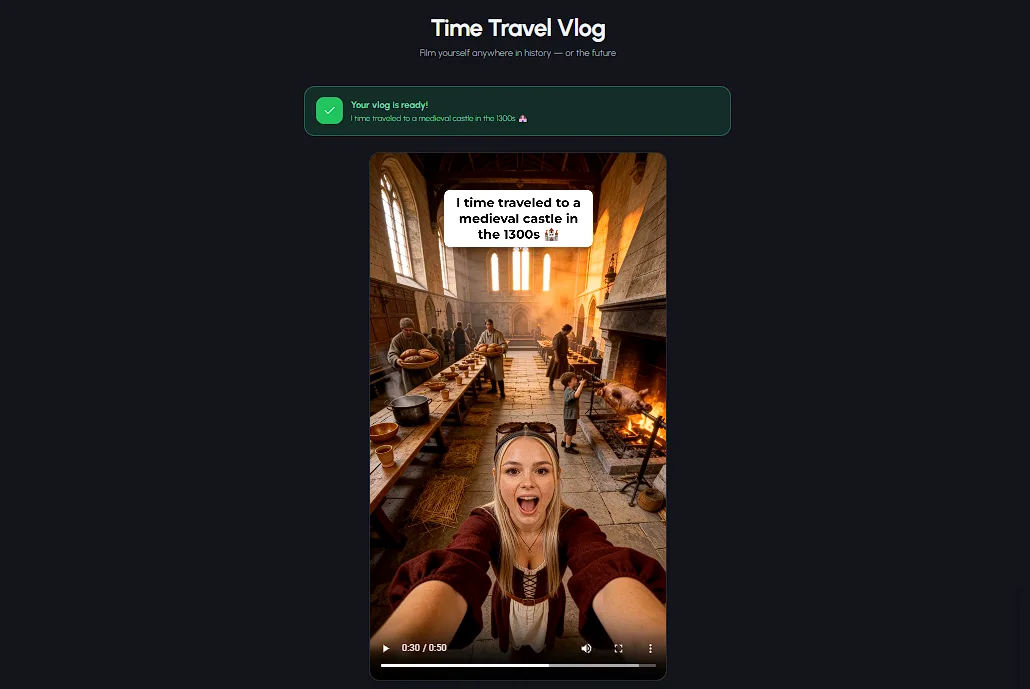
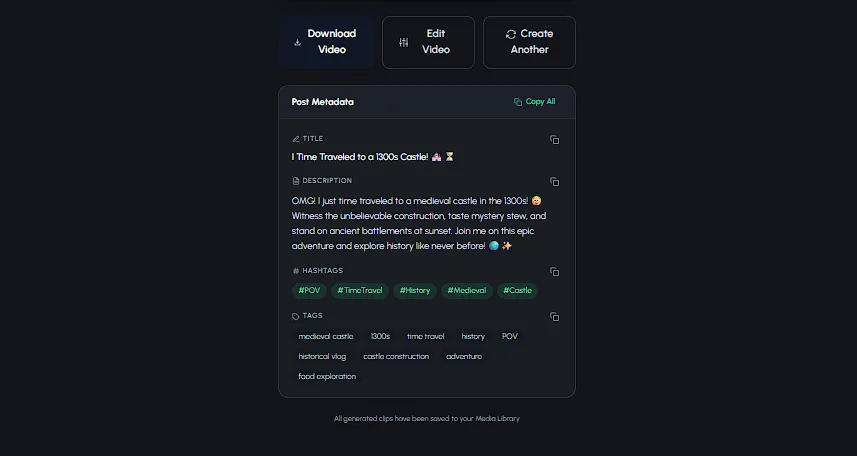
When it's done, you can download instantly or open the timeline editor to reorder clips, regenerate any single clip, switch between 8 caption styles, and add background music. AutoClips also auto-generates your post title, description, hashtags, and tags with copy buttons — so posting takes seconds, not another editing session.
Want the full walkthrough with every era preset explained? Start with our AI time travel video generator guide — Rome is one of six built-in destinations.
Get Rome Right: Accuracy Notes Viewers Actually Check
Historians have publicly picked apart sloppy AI history videos. Comment sections do it faster. These four details separate a credible ancient Rome vlog AI creators can be proud of from one that gets ratioed.
Gladiators Rarely Fought to the Death
Trained gladiators were expensive investments, and most matches ended with both fighters alive. A vlog where your gladiator fears death but expects to survive is both more accurate and more dramatic than a bloodbath — and it's the first thing history buffs check in the comments.
Rome Was Painted, Not Marble-White
Temples and statues were covered in bright paint, streets had raised stepping stones over running gutters, and apartment blocks towered over narrow alleys. Mention the color and the noise in your script — it signals you did the homework.
Match the Armor to the Century
The banded plate armor everyone pictures belongs to the imperial era, not the Republic. For a Rome 50 BC legionary, chain mail is the right call; for gladiators, each fighter type had distinct gear — a retiarius carried a net and trident, not a sword and shield.
Respect the Pompeii Timeline
The eruption built over hours: ordinary morning, midday ash column, deadly surges much later. A vlog where the city is instantly on fire reads as fake. Pace your clips along the real progression and the dread does the work for you.
Sample 6-Clip Pompeii Vlog Script
Six clips at 8-10 seconds each lands around the one-minute mark. Here's the warn-and-fail arc, clip by clip. The AI writes your script for you — but this is the shape it aims for, and you can steer it with your scenario text.
Clip 1 — The Hook
"So I'm literally in Pompeii. It's August 24th, 79 AD — and that mountain behind me? Nobody here knows what it's about to do."
Clip 2 — Ordinary Morning
"The bakery just pulled fresh loaves, the fountain line is ten people deep... everyone's joking about the tremors like they're nothing."
Clip 3 — First Signs
"Okay, the ground just shook again and the birds have gone completely silent. There's a column of smoke starting over Vesuvius."
Clip 4 — The Warning Fails
"I told a merchant to get his family to the boats. He laughed at me. I'm begging people to leave and they will not listen."
Clip 5 — Escalation
"Ash is falling like grey snow. It's midday and the sun is gone. Now they're running — everyone is running."
Clip 6 — Cliffhanger
"The cloud is coming down the mountain. If you're seeing this... remember Pompeii. Follow to find out which era I wake up in next."
One App vs the DIY Stack for Roman POV Videos
| What You Need | AutoClips Time Travel Vlog | DIY Multi-App Workflow |
|---|---|---|
| Apps required | 1 | 4-5 |
| Consistent character across clips | Automatic | Manual, often fails |
| Talking clips with real voice | Built in | Separate voice tool |
| Word-synced captions | Built in, 8 styles | Hand-timed in an editor |
| Title banner & 9:16 vertical output | Automatic | Manual layout work |
| Time per video | Minutes | ~4 hours reported |
| Skills needed | Type a scenario | Prompting + editing |
Can Ancient Rome Vlogs Actually Make Money?
Yes — and the format has a structural advantage most creators miss. TikTok's Creator Rewards Program only pays on videos 60 seconds or longer, at roughly $0.40-$1.00 per 1,000 qualified views, so a million-view Pompeii vlog can be worth $400-$1,000. An 8-clip Time Travel Vlog runs 64-80 seconds, so it clears that bar by default — while single-clip AI videos earn nothing from the program.
Creator Rewards
8-clip vlogs pass the 60-second minimum automatically — history sits in the education-adjacent niches at the top of the RPM range
Audience Compounding
One consistent character across eras turns one-off views into followers — the trend's biggest accounts grew on serialized characters, not single hits
Multi-Platform
The same 9:16 vlog posts to TikTok, YouTube Shorts, and Instagram Reels — three monetization pools from one render
For the full history-niche earnings breakdown — YouTube RPMs, sponsorships, and the 2026 AI-disclosure rules — see our faceless history channel guide. New to faceless content entirely? Start with how to start a faceless YouTube channel in 2026, then scale posting with faceless TikTok automation.

Frequently Asked Questions
Everything creators ask about making ancient Rome AI videos
What would it be like to live in ancient Rome?
For most Romans, daily life meant crowded apartment blocks, noisy streets paved with stepping stones, public baths, and a forum packed with merchants, politicians, and street food vendors. Slaves and laborers did most of the physical work, while citizens spent surprising amounts of time at games, temples, and markets. That texture — the smells, the noise, the routines — is exactly what makes ancient Rome POV videos so watchable: viewers get to experience an ordinary day in an extraordinary world.
How do I make a 'POV: you wake up as a gladiator' video?
Open AutoClips' Time Travel Vlog, pick or create your character, then type a scenario like 'I wake up as a gladiator in Rome on the morning of my first fight, 80 AD.' The AI writes a hook-first script, generates 4-8 talking selfie clips with a real voice performance and word-synced captions, and stitches them into one vertical video. The character's face and armor stay consistent in every clip automatically, which is the part DIY workflows struggle with most.
What happened in Pompeii on the day Vesuvius erupted?
In 79 AD, Mount Vesuvius erupted and buried Pompeii under ash and pumice. The eruption began around midday with a massive column of ash that rained down on the city for hours, and it ended with pyroclastic surges — fast-moving waves of superheated gas and debris — that killed those who had stayed behind. That timeline is a gift for creators: it gives your Pompeii vlog a natural three-act structure from ordinary morning to desperate escape.
How do I make an AI video of myself in ancient Rome?
Upload a photo of yourself in the 'Who's traveling?' step of the Time Travel Vlog and the AI places you in the era — toga, armor, or tunic included — while keeping your face consistent across every clip. You can also use a saved character from My Characters or generate a brand-new one if you'd rather stay faceless. Either way, you never film anything and never appear on camera unless you choose to.
What are the best Roman history scenarios for POV videos?
The three proven clusters are gladiator arena stories (a fighter's last match, a new recruit's first day), the Pompeii eruption of 79 AD (the date-stamped disaster where you try to warn everyone and fail), and daily life in Rome around 50 BC (forum merchants, legionaries, a senator's household). Disaster scenarios tend to spike hardest, while daily-life scenarios build loyal followings because viewers return for the next 'ordinary day' in history.