Medieval AI Video
Black Plague & Middle Ages POV Vlogs That Go Viral
The medieval AI video is the biggest proven winner in the entire AI time travel trend. One Black Plague POV passed 19.5 million views, and the most-watched plague video hit 53 million. This guide covers the three medieval formats that work — disaster POVs, peasant daily life, and medieval found footage — and how to make yours in minutes with one app, one consistent character, and zero editing.
Watch: How to Make an AI Time Travel Vlog
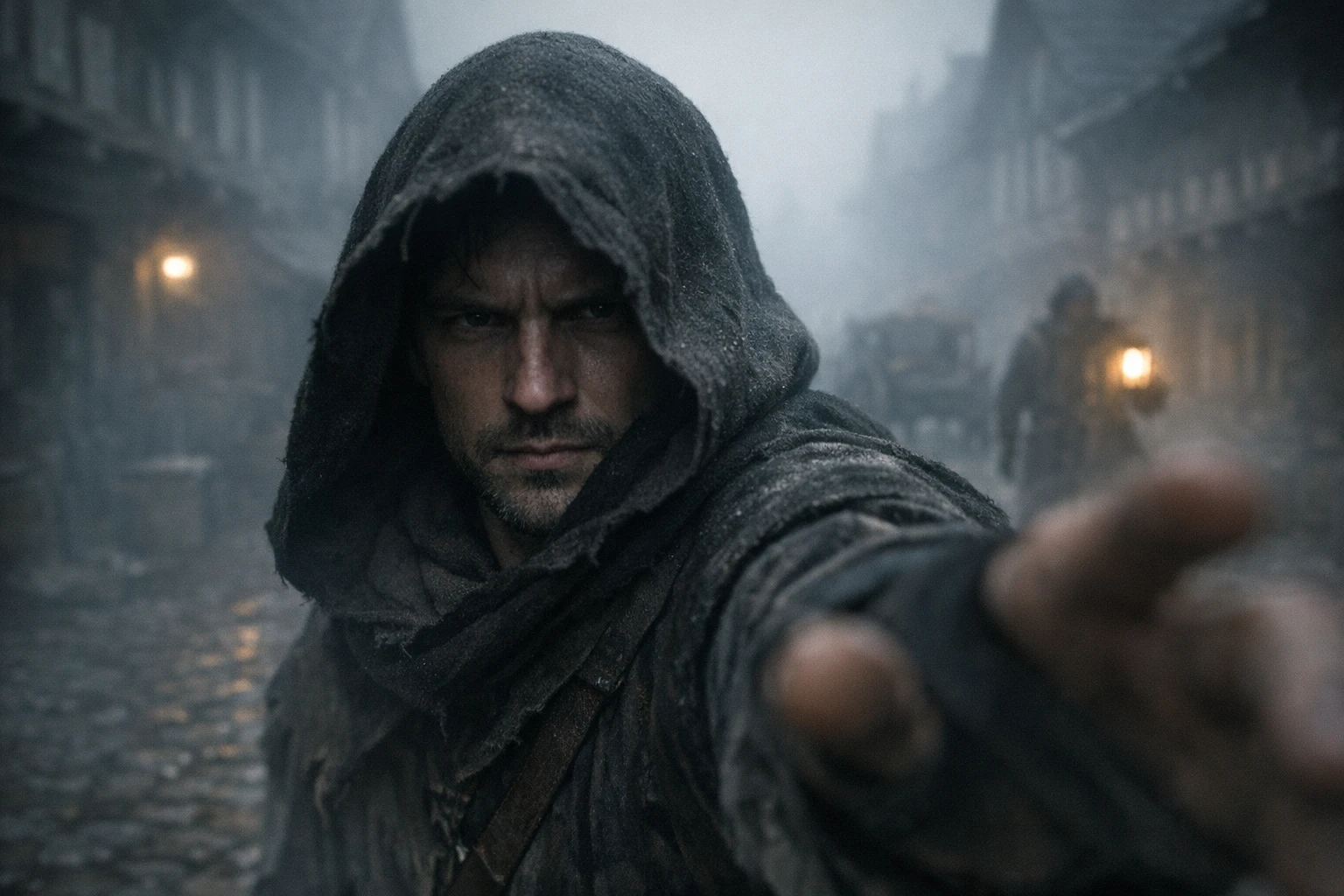
What Is a Medieval AI Video?
A medieval AI video is a first-person, selfie-style vlog set in the Middle Ages — usually somewhere between 1000 and 1500 AD — created entirely with AI. The narrator holds the camera at arm's length and talks you through their day while a plague-stricken street, a castle courtyard, or a muddy harvest field moves behind them. The most common framing is the one you've seen all over your feed: "POV: you wake up in the Middle Ages."
It is one branch of the wider trend built around the AI time travel video generator format — the same wave that produced Ancient Egypt pyramid-builder POVs and Roman gladiator vlogs. But the medieval era is where the format's biggest numbers live, because no other era combines danger, atmosphere, and name recognition like the Black Plague does.
A finished medieval vlog AI video has a recognizable anatomy: 4-8 short talking selfie clips, a hook in the first three seconds ("So I'm literally in London in 1348..."), word-synced captions, a title banner across the top, and a vertical 9:16 frame built for TikTok, YouTube Shorts, and Instagram Reels. The single hardest part — keeping the same face and outfit across every clip — is exactly where most DIY attempts fall apart.
Why Black Plague POV AI Videos Dominate the Trend
Every era in the time travel trend has viral hits. The Middle Ages has the records.
19.5M+
views on "POV: You Wake Up in 1351 During the Black Plague"
53M
views on the most-watched plague POV video
4.4M
likes on @the_pov_lab's Black Plague 1351 video
702K
likes on the "woman doctor in the Black Plague 1347" POV
The numbers are documented, not folklore. Dexerto's coverage of the trend tracked @timetravellerpov's Black Plague POV past 19.5 million views, and indy100 reported the most-watched plague video — misty streets, coughing townsfolk, a plague doctor's bell — at 53 million views.
Why does this era win? Contrast and stakes. A cheerful selfie narrator in the deadliest pandemic in human history is the sharpest possible collision between format and setting. Viewers already know how the story ends — a third of Europe dies — which gives every clip built-in dramatic irony. And unlike a gladiator fight or a pyramid build, the plague is slow, creeping, and everywhere, so the "try to warn them and fail" story arc writes itself.
The 3 Medieval AI Video Formats That Actually Work
Pick one lane per video. Mixing them dilutes the hook.
1. Disaster POV: The Black Plague, 1347-1351
The proven heavyweight. The formula: your character wakes up in a plague city, notices the first wrong details (empty market stalls, tolling bells, a cart in the distance), realizes what year it is, tries to help or warn people, and fails. Every mega-viral medieval video follows some version of this arc.
The three highest-performing character variants are the ordinary peasant (the 19.5M-view video), the plague doctor making rounds, and the woman healer — @histairy_films' "woman doctor in the Black Plague 1347" pulled 702K likes because a female medical POV in 1347 adds a second layer of stakes on top of the disease itself.
2. Day in the Life: Peasants, Knights & Castle Living
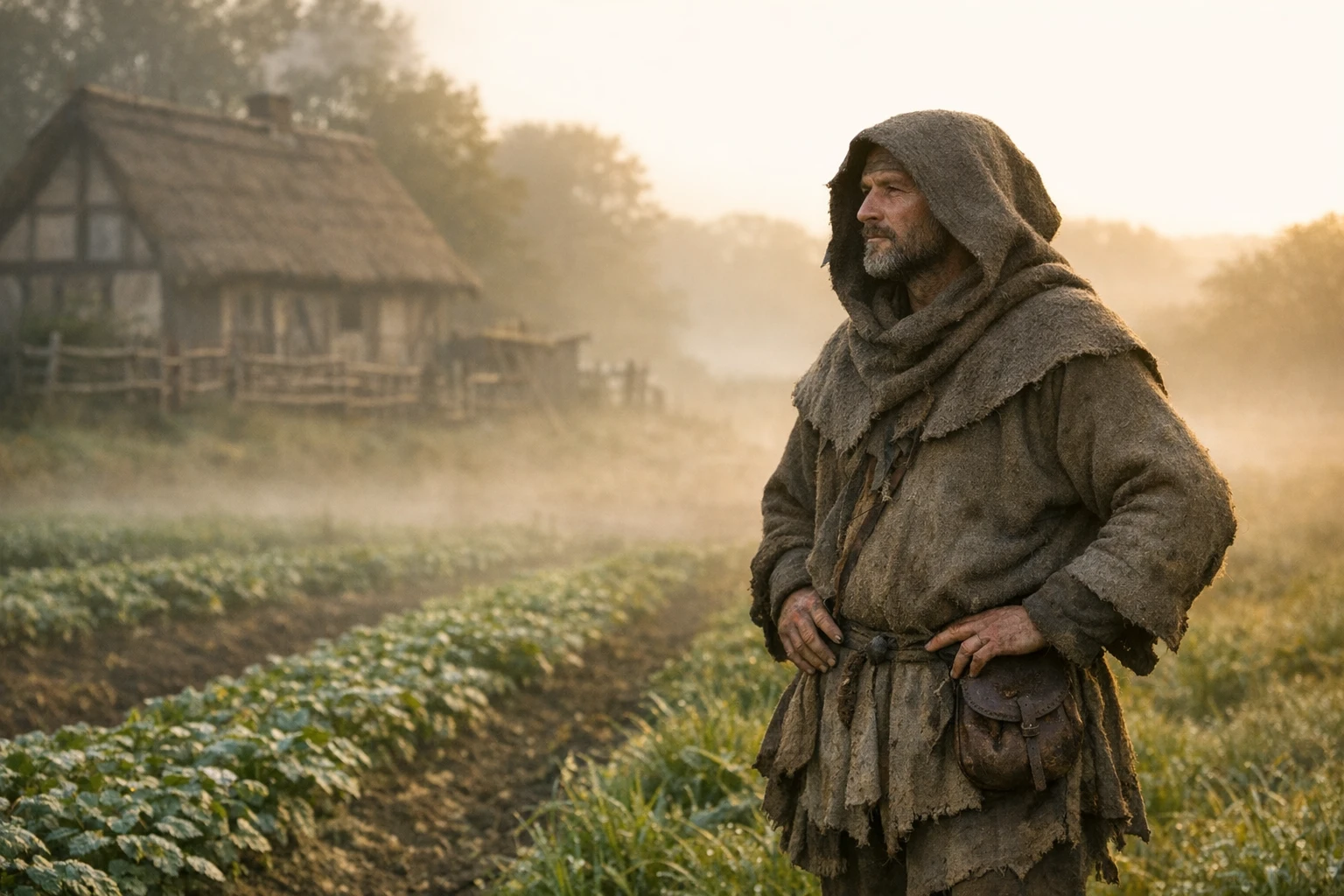
"Day in the life of a medieval peasant" is an evergreen search that video platforms currently dominate — there's almost no good written guidance, and the demand never dips because school history classes refill the audience every year. The appeal is texture, not terror: waking with the sun, bread and pottage, field labor, church bells, and bed by dark.
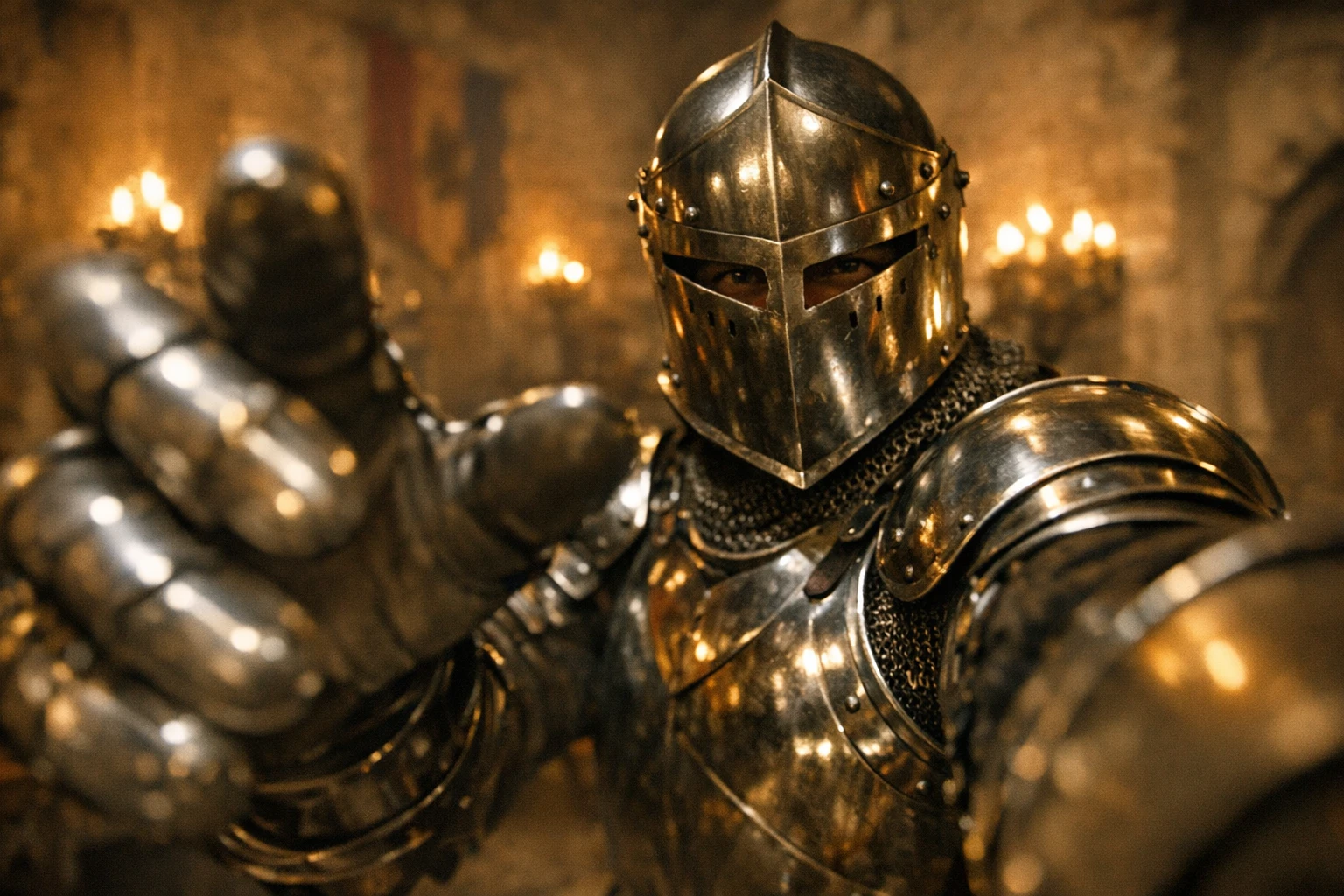
The knight POV AI video is the aspirational flip side — armor fittings, training in the yard, the nerves before a siege. Castle daily life (servants, feasts, falconry) sits in between. These videos trade the disaster arc for a "you'd never survive this" fascination, and they're the easiest entry point if you'd rather not build content around a pandemic.
3. Medieval Found Footage: The Analog-Horror Spin
"Medieval found footage" has its own TikTok Discover page — and those pages only exist for phrases with real search volume. The aesthetic borrows from analog horror: grainy, unsteady clips framed as recovered recordings from a time that couldn't have produced them. An abandoned plague village at dusk. A torch guttering out in a castle corridor. Something moving at the treeline.
Right now only raw user uploads rank for this format — no articles, no guides. That makes it the least crowded lane on this page. The trick is restraint: quieter narration, longer pauses, and a final clip that cuts before the reveal.
Five Apps and Four Hours — or One App and a Few Minutes
Every tutorial for this trend teaches the same exhausting pipeline. Fast Company reported that the trend's top creator spends around four hours per video juggling separate tools.
The Multi-App Way
- ✗Write and rewrite prompts in a chat assistant
- ✗Generate stills in an image tool, then animate them in a separate video animator
- ✗Record narration in a voice tool, then sync it by hand
- ✗Assemble clips and captions in an editor
- ✗Watch your character's face change between every clip
With AutoClips Time Travel Vlog
- Type your era — the AI writes a hook-first script
- 4-8 talking selfie clips with a real AI voice performance
- Face and outfit stay consistent across every clip, automatically
- Word-synced captions, title banner, 9:16 — stitched into one video
- No prompt engineering, no model picking, no editor required
How to Make a Medieval AI Video in 3 Steps
From blank screen to finished Black Plague vlog in minutes. For the full walkthrough of the format, see our guide on how to make time travel vlogs with AI.
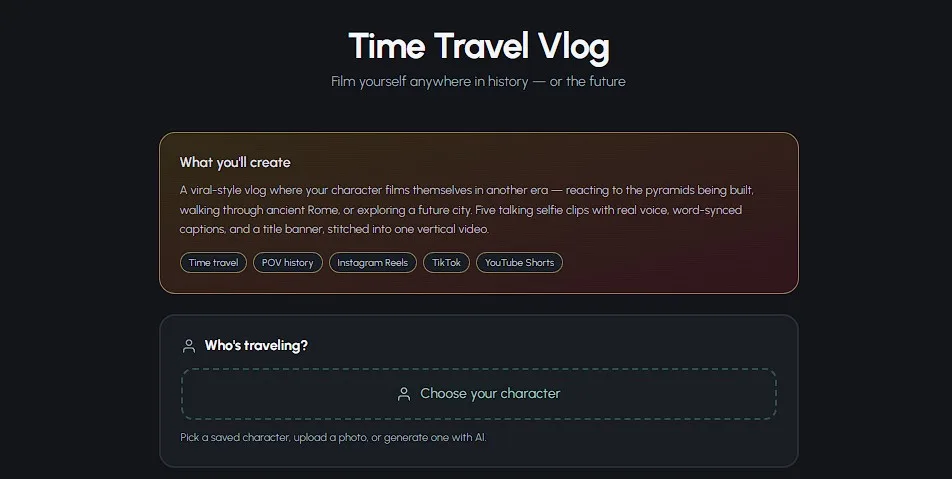
Pick Who's Traveling to the Middle Ages
Choose a saved character from My Characters, upload a photo to put yourself in 1348, or generate a new character with AI. Whichever you pick, that face and outfit will stay consistent across every clip — the exact thing multi-app workflows can't do.
Type Where — and When — You're Going
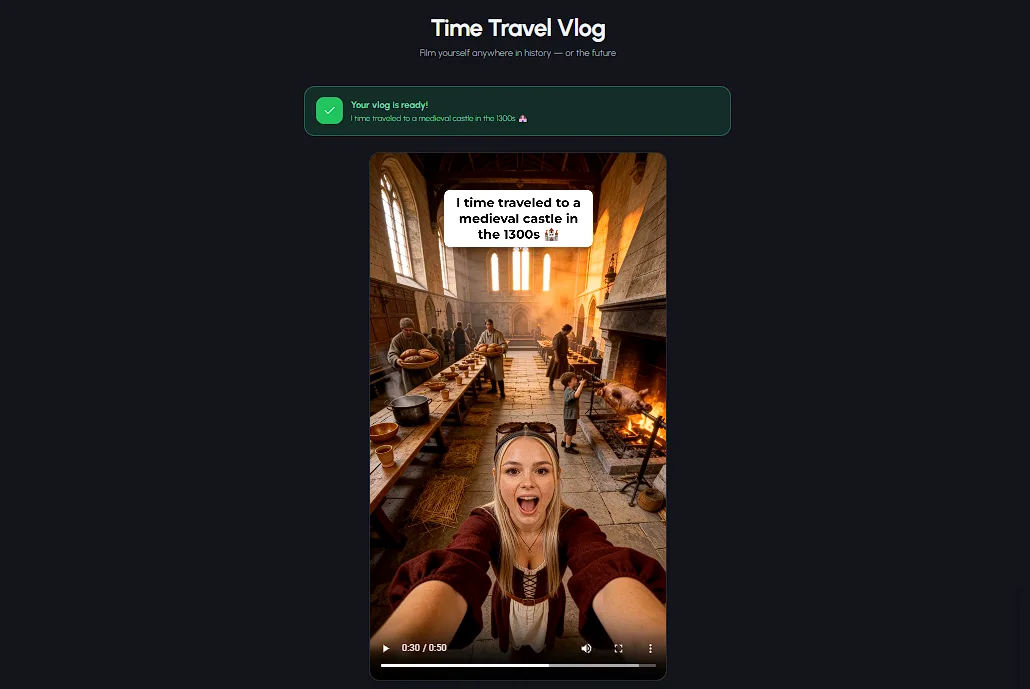
Tap the built-in "A medieval castle in the 1300s" preset, or type your own destination in plain English: "London, 1348, at the height of the Black Plague" or "a village emptied by the plague, found-footage style". No prompt engineering — you describe the scenario the way you'd describe it to a friend.

Pick Quality, Set Clip Count, Create
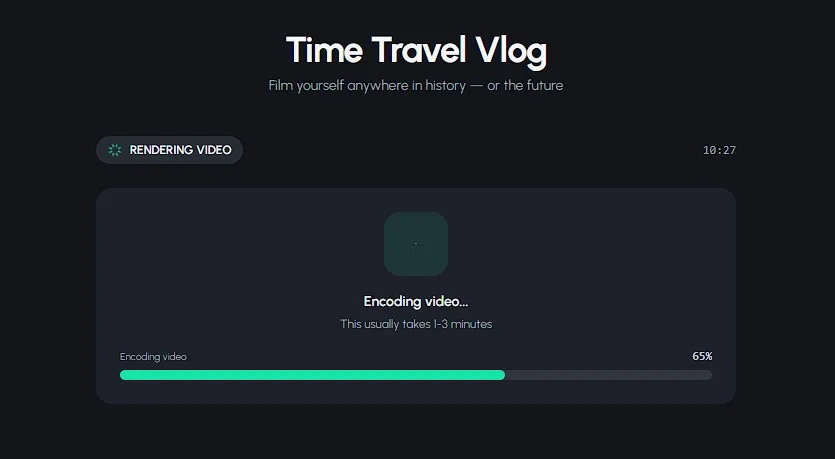
Choose Pro Max for the most cinematic motion (10-second clips), Pro for the sharpest lip-sync (8-second clips), or Lite for quick drafts. Set 4-8 clips — five clips is roughly a 50-second video — and click Create My Vlog. The AI writes the script, generates every talking selfie clip, and encoding usually takes 1-3 minutes.
What Comes Out the Other Side
A finished vertical vlog with a title banner ("I time traveled to a medieval castle in the 1300s"), word-synced captions, and your character talking to camera in every clip. From there you can Download, open the timeline editor to reorder or regenerate clips — with 8 caption styles, 5 caption positions, and a background music library — or hit Create Another.
AutoClips also auto-generates your post metadata — title, description, hashtags, and tags with one-tap copy buttons — and saves every clip to your Media Library for reuse. Posting daily stops being a production problem.
Get the Middle Ages Right: The Accuracy Checklist
Historians are watching this trend — and calling out the sloppy videos by name. Dr Amy Boyington described one viral medieval video as "amateurish" for anachronisms like glazed windows in peasant homes and a train track in the background, and historian Jo Teeuwisse, known as Fake History Hunter, has published detailed accuracy reviews of AI history content, including the myth that medieval streets were uniformly filthy.
Accuracy isn't just about avoiding embarrassment — the comment section correcting you is engagement you don't control. A quick pre-post check turns the trend's biggest criticism into your credibility edge. Watch for these five in your medieval clips:
No glass windows in peasant homes
Glazed windows were luxury items for churches and the wealthy. Peasant cottages had wooden shutters or oiled cloth — this is the exact anachronism historians flagged in a viral video.
No potatoes, tomatoes, or corn
All three arrived in Europe after 1492. A 1348 market stall should show bread, pottage grains, onions, cabbage, and root vegetables — not a New World harvest.
Streets weren't uniformly filthy
The waste-filled-street trope is a Hollywood shorthand that Fake History Hunter specifically debunks. Towns had cleaning ordinances; mud is accurate, sewage rivers are not.
The beaked plague mask is (mostly) too early
The iconic beaked costume isn't documented until the 1600s — nearly three centuries after the Black Death. Use it in 1348 and the history side of the comments will let you know.
Color existed — and so should labeling
Medieval clothing was dyed in reds, blues, and greens, not just brown rags. And whichever era you render, label the video as AI-created — it protects your credibility and keeps you on the right side of platform disclosure rules.
10 Ready-to-Use Medieval POV Scenarios
Type any of these straight into the era box. Each one is a full video waiting to happen.
POV: you wake up in 1351 during the Black Plague
The proven blockbuster — 19.5M+ views for the original. Peasant variant, try-to-warn-them arc.
POV: you're a plague doctor in 1348 London
Making rounds as the bells toll. Skip the beak mask for accuracy points — or lampshade it.
POV: you're a woman healer during the plague, 1347
The 702K-like variant. Double stakes: the disease, and being a woman practicing medicine in 1347.
POV: you're a serf at harvest, 1300
The daily-life anchor. Dawn fields, pottage lunch, church bells — pure texture.
POV: knight the night before a siege
Armor fittings, bravado slipping into fear. The strongest knight POV framing.
POV: monk copying manuscripts in a scriptorium
Quiet, oddly soothing, and a natural fit for calmer audiences. Candlelight does the work.
POV: the Dancing Plague of 1518, Strasbourg
From the documented winning-era formula — hundreds dancing uncontrollably, nobody knows why.
POV: castle servant during a royal feast, 1300s
Upstairs-downstairs contrast. You carry the roast peacock; you eat the leftovers.
Medieval found footage: last record of an abandoned village
The analog-horror lane. Quiet narration, one wrong detail per clip, cut before the reveal.
POV: pilgrim on the road to Canterbury, 1380s
A built-in travel-vlog structure — new companions and roadside dangers every clip.
Want more eras? Browse 50 time travel vlog ideas from the Ice Age to the year 3000, or jump to the Ancient Egypt and Ancient Rome era guides.
A Sample 6-Clip Black Plague Vlog Script
AutoClips writes a hook-first script for you automatically, but here's the shape of one that works — so you can recognize a good structure and tweak the output to your voice. Six clips at 8-10 seconds each lands around a minute of video.
Clip 1 — The Hook
"So I'm literally in London in 1348 and everyone is acting like nothing is wrong. Those bells have not stopped ringing since I woke up."
Clip 2 — The Wrong Details
"Half the market stalls are empty. The baker just told me his whole street is 'sleeping.' Nobody here says the word out loud."
Clip 3 — Realization
"I just did the math on the date. 1348. This is the year the Black Death reaches London. It kills a third of Europe and it is already here."
Clip 4 — The Attempt
"I tried to tell the physician it spreads from the fleas, not from 'bad air.' He told me to buy a posy of flowers and pray harder."
Clip 5 — The Failure
"They're marking doors with crosses now. The family across the lane got marked this morning. There is nothing I can do and I knew that when I got here."
Clip 6 — The Cliffhanger
"I woke up with a cough. It's probably the smoke from the fires. It's probably the smoke. I'll update you tomorrow — if I can."
Notice the arc: hook, wrong details, realization, attempted intervention, failure, cliffhanger. It's the same structure behind the biggest videos in the trend — and it's the default shape the AI time travel video generator aims for when it writes your script.
Ways to Make a Medieval AI Video, Compared
| Feature | AutoClips | Multi-App DIY | Generic AI Video Tools |
|---|---|---|---|
| Consistent character across clips | Automatic | Manual, error-prone | No |
| Talking selfie clips with real voice | Yes | Separate voice tool | Rarely |
| Word-synced captions | Built in, 8 styles | Editor required | Basic |
| Title banner + 9:16 vertical | Automatic | Manual | Varies |
| Post title, hashtags & tags | Auto-generated | Write your own | No |
| Time per video | Minutes | ~4 hours | 1-2 hours + editing |
| Apps needed | 1 | 4-5 | 2-3 |
Can You Make Money with Medieval AI Videos?
TikTok Creator Rewards
$0.40-$1.00
per 1,000 qualified views in 2026 — a 1M-view video is roughly $400-$1,000
History Niche RPM
$0.60-$1.00
education-adjacent niches like history report the top of the Creator Rewards RPM range
Completion Rate
72%
history content's average completion rate on TikTok, vs 54% for general entertainment
One catch matters for this format: TikTok's Creator Rewards only pays on videos 60 seconds or longer. That's why the clip count setting isn't cosmetic — an 8-clip medieval vlog at 8-10 seconds per clip clears the 60-second bar comfortably, while a 4-clip draft won't qualify.
For the full earnings math across platforms — YouTube RPMs, sponsorships, and the 2026 AI-disclosure rules — read our faceless history channel guide. And if you're building a posting habit rather than a one-off, our faceless TikTok automation guide covers running an account without ever showing your face.
Frequently Asked Questions
Everything creators ask about medieval AI videos
What was daily life like for a medieval peasant?
A medieval peasant's day ran from sunrise to sunset: field work at dawn, a midday meal of bread, pottage, and ale, then more labor until the church bells rang evening prayers. Most families lived in one-room homes with dirt floors, open hearths, and unglazed windows covered by wooden shutters. It is exactly this texture — the mud, the bells, the smoke — that makes 'day in the life of a medieval peasant' AI videos so watchable when they get the details right.
How do I make a 'POV: you wake up in the Middle Ages' video?
Open AutoClips' Time Travel Vlog, pick who's traveling (a saved character, a photo of yourself, or an AI-generated character), then type your destination — 'A medieval castle in the 1300s' is a built-in preset. Choose your quality tier and clip count, click Create My Vlog, and the app writes a hook-first script, generates 4-8 talking selfie clips with a consistent character, and stitches them into one vertical video with voice and word-synced captions. Encoding usually takes 1-3 minutes.
Why did the Black Plague POV videos go viral?
Because they combine extreme stakes with a familiar selfie format: a modern-looking narrator talking to camera while one of history's deadliest disasters unfolds behind them. 'POV: You Wake Up in 1351 During the Black Plague' passed 19.5 million views, and the most-watched plague POV — misty streets, coughing townsfolk, a plague doctor's bell — racked up 53 million. The tension between casual vlog delivery and life-or-death setting is what stops the scroll.
Are AI medieval videos historically accurate?
Often not — and historians have noticed. Dr Amy Boyington called one viral medieval video 'amateurish' for anachronisms like glazed windows in peasant homes and a visible train track, and Fake History Hunter has published detailed critiques of AI history content. The fix is a simple accuracy pass: check windows, crops, clothing, and street scenes against the era before you post, and label the video as AI-created.
What is 'medieval found footage' on TikTok?
Medieval found footage is the darker, analog-horror spin on the time travel vlog: grainy, unsettling clips framed as recovered recordings from the Middle Ages — an abandoned plague village, a torch going out in a castle corridor. It has its own TikTok Discover page, which only exists for phrases people actually search. You can create the same first-person feel with a Time Travel Vlog by writing a quieter, eerier scenario instead of a bright travel-diary one.