How to Make Videos Like Chloe VS History
(Without 5 Different AI Tools)
Chloe VS History hit roughly one million cross-platform followers from about 21 videos — her Titanic video alone passed 4.3 million views. If you've been searching how to make videos like Chloe VS History, here's the honest answer: it's a formula, not a fluke. This guide decodes her format and shows you how to recreate it in one app, in minutes, without juggling five different AI tools.
Watch: How to Make an AI Time Travel Vlog

Is Chloe VS History Real? Meet the AI History Influencer
Let's answer the biggest question first: no, Chloe VS History is not a real person. She is a fully AI-generated character — an "AI history influencer" who films selfie-style vlogs from the deck of the Titanic, the streets of Pompeii, and plague-era London. The account launched in February 2026, and in May 2026 Sky News identified the person behind her: UK creator Jonathan Laramy.
What makes her worth studying is the efficiency. From about 21 videos, Chloe reached roughly 624,000 Instagram followers, 334,000 YouTube subscribers, and 100,900 TikTok followers. Her most-viewed video — trying to warn Titanic passengers about the iceberg — hit 4.3 million views. BBC News, Fox News, and the Washington Post all covered her. Most creators post daily for years and never touch those numbers.
Chloe is the flagship of a much bigger wave. The AI history POV trend — first-person "POV: you wake up in..." videos set in past eras — had already racked up tens of millions of views before she arrived. She simply gave the format a face, a name, and a recurring storyline. And that's the part you can copy with an AI time travel video generator instead of a five-app production pipeline.
The rest of this guide breaks down exactly why her 21 videos outperformed channels with a thousand uploads, the five-part script structure she uses in nearly every video, and how to reproduce the whole thing — consistent character, talking selfie clips, captions, title banner — in a single app.
Why 21 Videos Beat Channels With 1,000: The Format, Decoded
Chloe VS History's growth wasn't luck. Strip the videos down and you find four deliberate decisions working together.
Famous Events, Zero Explanation Needed
She doesn't cover obscure history. She picks the Titanic, Pompeii, the Black Plague — events every viewer already knows ending badly. That shared knowledge does the storytelling for her: the moment you see a smiling woman on the Titanic's deck, the dread is already in your head. The hook lands in under three seconds because you brought the context with you.
Modern Girl, Ancient Disaster
The visual contrast is the scroll-stopper. A modern young woman with a phone, filming herself in a world of corsets, togas, or plague doctors, creates instant cognitive whiplash. It's the same trick behind every viral "POV: you wake up in..." video — the anachronism IS the thumbnail.
One Continuous Character
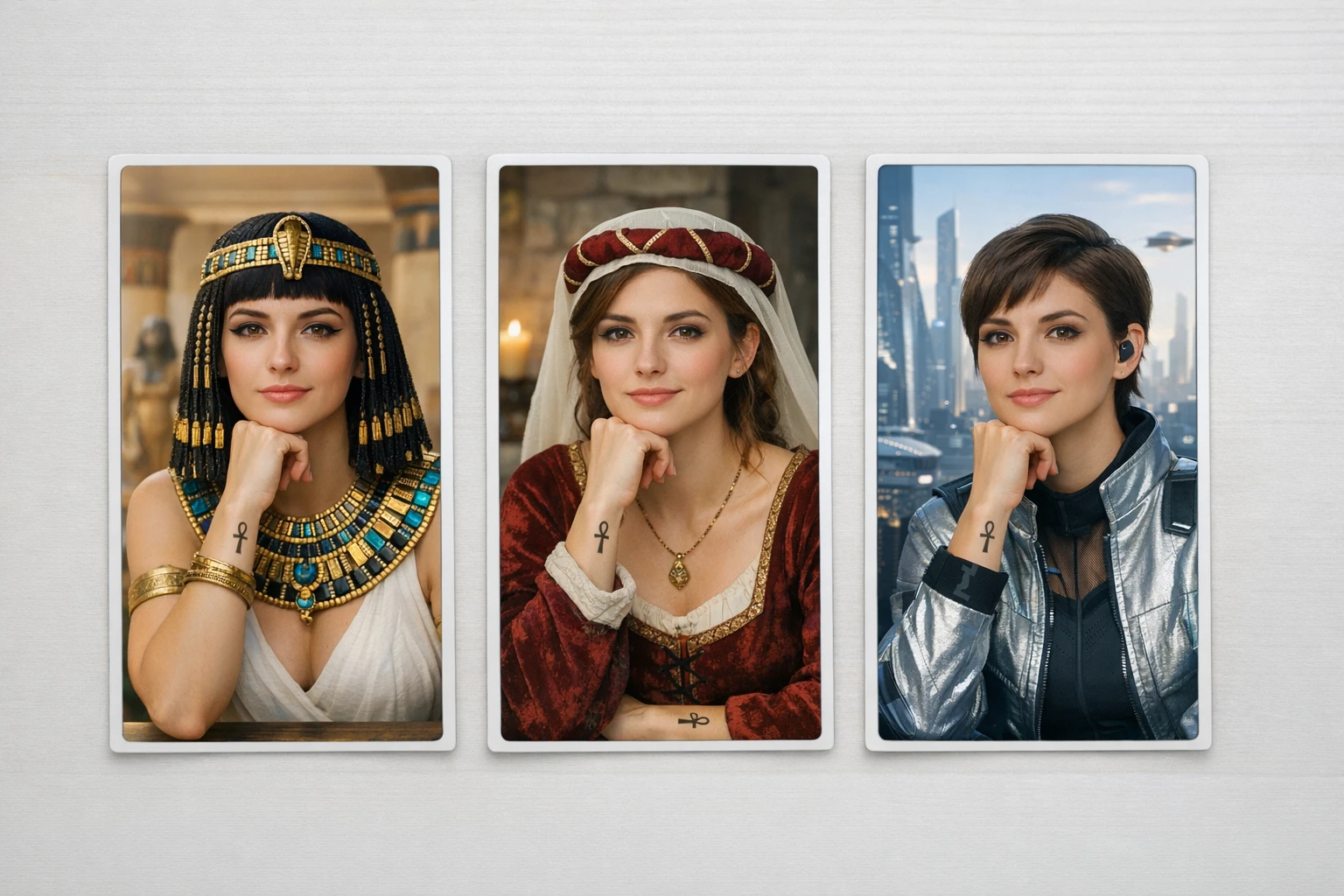
Chloe looks like Chloe in every single video, down to a signature tattoo-style marker that makes her instantly recognizable. That consistency turns one-off viewers into followers of a person, not a format. It's also the single hardest thing to pull off with a DIY workflow — which is exactly why so few creators managed to copy her.
Handheld Selfie Framing
Every clip is framed like a FaceTime call from 79 AD. The selfie format is social media's native language — it reads as intimate and real even when the content is obviously AI. Documentary-style history videos feel like homework; a selfie vlog from the Colosseum feels like a friend in trouble.
The Chloe VS History Video Structure (Steal This 5-Part Script)
Watch her videos back to back and the same skeleton appears every time. It's a classic Cassandra arc — she knows the disaster is coming, tries to warn everyone, and fails, because history always wins. Here's the structure, beat by beat:
1. Hook (first 3 seconds)
A date-stamped danger statement. "April 14th, 1912. I'm on the Titanic — and I'm the only person on board who knows what happens tonight."
2. Arrival
Establish the era with one or two sensory details. "First class smells like cigars and fresh paint. This ship is five days old."
3. Exploration
Two or three clips of daily life that make the era feel real — the grand staircase, the dinner menus, passengers boasting that the ship is unsinkable.
4. Attempted Intervention
She tries to change history. "I found an officer. I told him: iceberg, 11:40 PM, starboard side. He laughed at me."
5. Failure / Cliffhanger
History wins, and the video ends on the edge of the disaster. "It's 11:39. I can see it from the deck. Nobody believed me." Cut to black — and the viewer hits follow to see where she wakes up next.
Five beats, four to eight short clips, under a minute of runtime. That's the entire creative engine behind an account major news networks covered. The structure is free to steal — the bottleneck has always been production. Let's talk about that.
What Does Chloe VS History Use? The Multi-Tool Problem
The exact stack behind Chloe has never been fully confirmed — but every tutorial teaching this format walks you through the same painful pipeline: a chat assistant writes the script, an image tool generates character stills, a video animator turns stills into motion, a separate voice tool records the narration, and an editor stitches it all together with captions. Fast Company reported that the trend's top creator spends around four hours on every video with that workflow.
The 5-Tool Workflow
- ✗Write and rewrite prompts in a chat assistant, then re-prompt an image tool for a character sheet
- ✗Feed stills into a video animator one clip at a time — and pray the face doesn't change
- ✗Generate the voice in a separate tool, then line it up with lips that were never synced to it
- ✗Build captions and stitch everything together in an editor
- ✗Roughly four hours per video — with subscriptions to five different tools
With AutoClips
- Pick a character, type an era, click Create My Vlog — no prompt engineering, no model picking
- 4-8 talking selfie clips with a real AI voice performance, generated in one run
- Your character's face and outfit stay consistent in every clip, automatically
- Word-synced captions and a title banner built into the render
- One vertical 9:16 video, encoded in about 1-3 minutes
How to Make Videos Like Chloe VS History in One App (3 Steps)
AutoClips' Time Travel Vlog is a purpose-built AI time travel video generator — here's the whole workflow. For a deeper walkthrough with scripting tips, see our full guide on how to make time travel vlogs with AI.
Create Your Own "Chloe"
Pick who's traveling. You can choose a saved character from My Characters, upload a photo to put yourself in history, or generate a brand-new AI character. This is where Chloe's biggest advantage becomes yours: whoever you pick keeps the same face and outfit across every clip of the vlog — and across every future video — automatically.
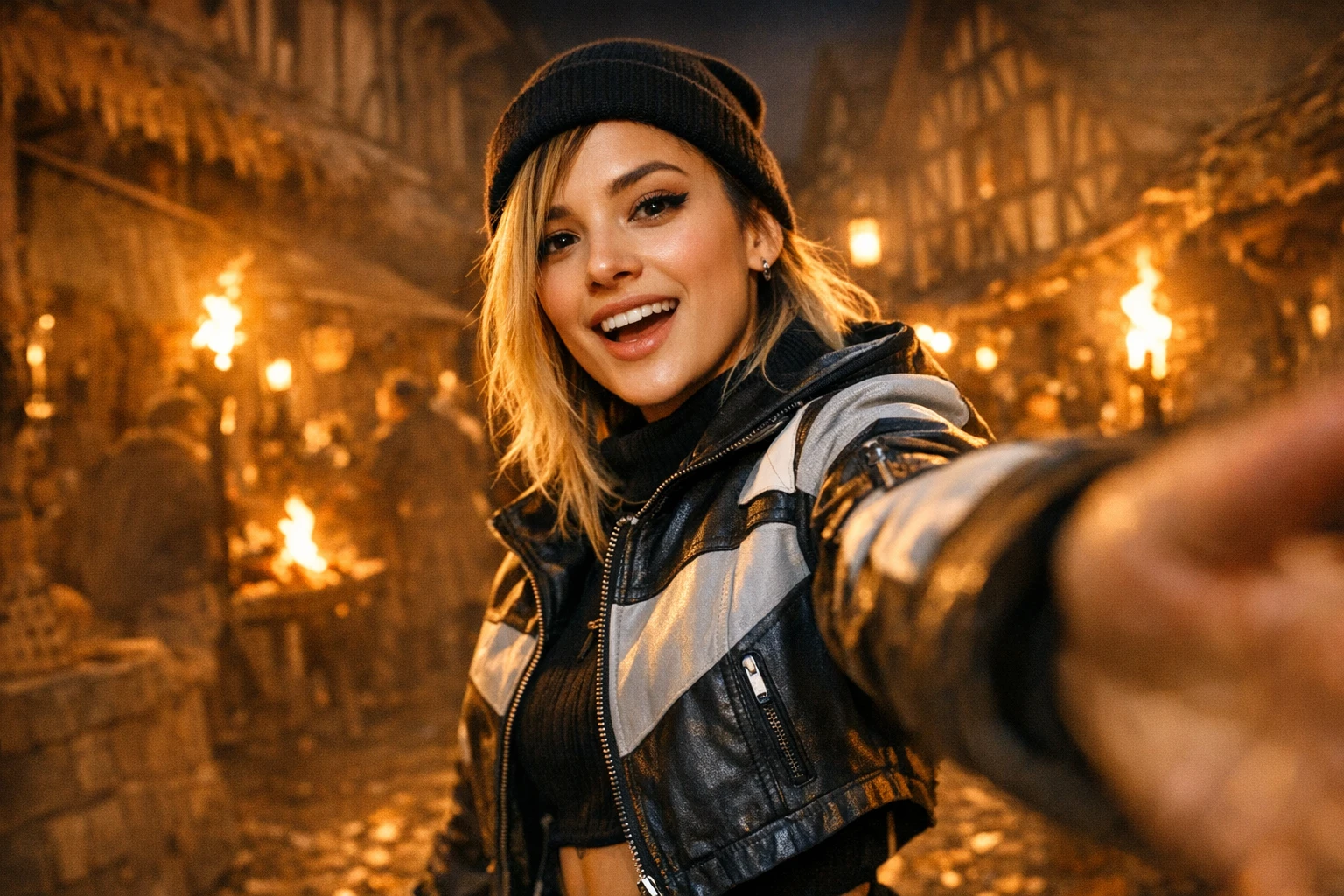
Take a page from her book and give your character one signature detail — a hair streak, a distinctive jacket, a visible marking. That's the recognition anchor that turns viewers into followers.
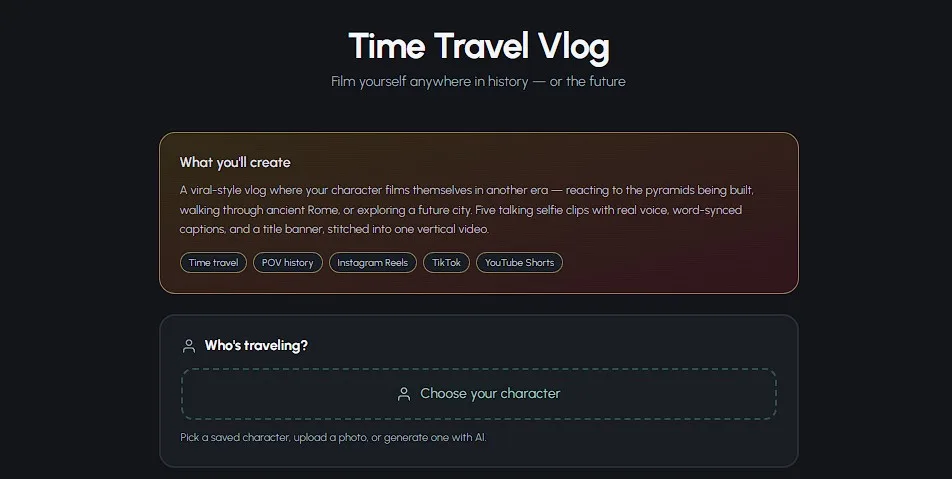
Type Where (and When) They're Going
Describe any destination in plain text — "the deck of the Titanic, April 1912" recreates her most viral video's setting. Or tap a preset chip: "Ancient Egypt while the pyramids were built", "Rome, 50 BC", "A medieval castle in the 1300s", "The Ice Age", "The dinosaur era", or "A city in the year 3000". Any era works, real or imagined.
Remember the format rule: famous events your audience already knows ending badly give you a three-second hook for free. Pompeii, the plague, the Titanic — pick a date your viewers will recognize with dread.

Pick Quality, Click Create, Post
Choose your video quality — Pro Max for the most cinematic motion (10-second clips), Pro for the sharpest lip-sync (8-second clips), or Lite for quick drafts — set the clip count between 4 and 8, and click Create My Vlog. The AI writes a hook-first script, generates every talking selfie clip, and stitches them into one vertical 9:16 video with word-synced captions and a title banner. Encoding usually takes 1-3 minutes.
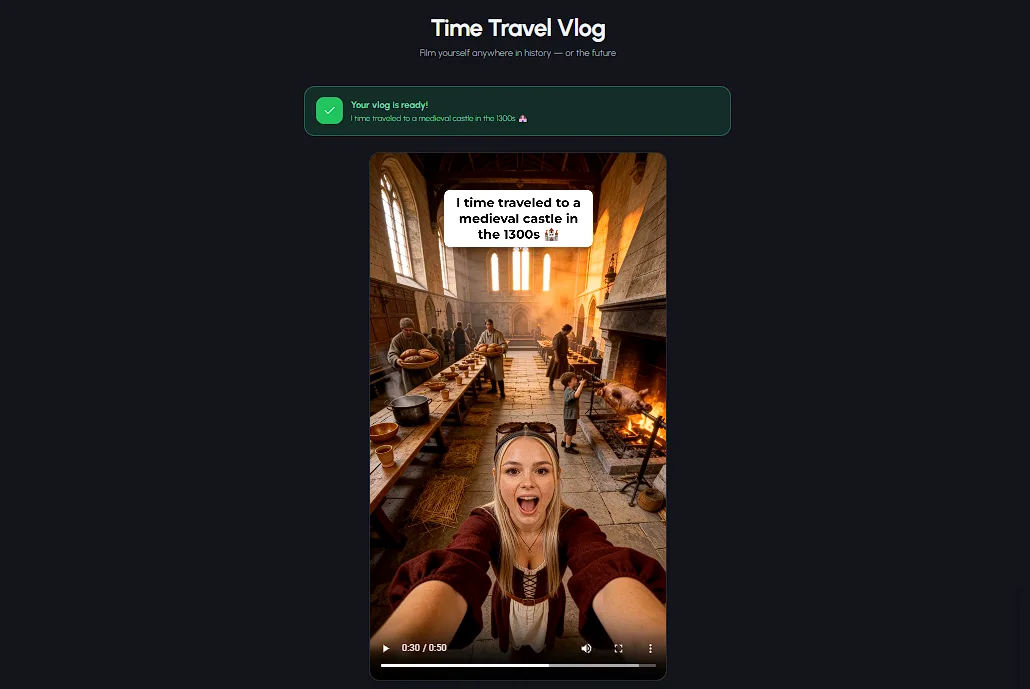
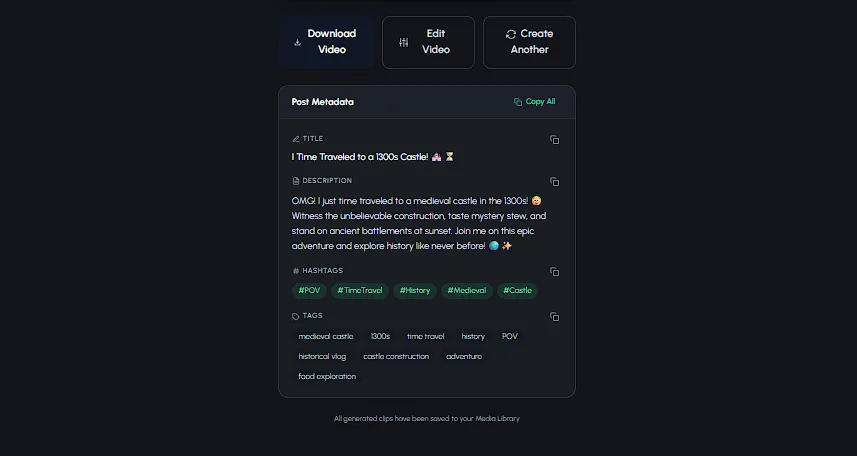
When it's done, you can download it, open the timeline editor to reorder or regenerate clips (with 8 caption styles, 5 caption positions, multiple colors, and a background music library), or hit Create Another. AutoClips even writes your post metadata — title, description, hashtags, and tags with copy buttons — so publishing takes seconds, not another editing session.
Don't Clone Chloe — Differentiate
A hundred exact copies of an AI time travel influencer will all lose to the original. The creators winning right now keep her formula and change the variables.
Pick Eras She Hasn't Touched
Chloe owns the Titanic and Pompeii. The Gold Rush, the Dancing Plague of 1518, the year 3000, the dinosaur era — all wide open. We've collected 50 proven scenarios in our list of time travel vlog ideas, each written as a ready-to-use one-liner.
Build a Different Persona
The modern-girl archetype is taken. A skeptical teenager, a grandmother historian, a future archaeologist visiting our present — a fresh persona changes every joke and every reaction. Save yours to My Characters once and reuse them in every video.
Win on Accuracy
Chloe's documented weakness is historical accuracy (more on that below). Getting the details right — clothing, streets, technology — earns you the history-nerd comment section she loses. Accuracy is a differentiator almost nobody in this niche is competing on.
Package Like a Series, Not One-Offs
Her cliffhanger endings make each video a season finale. Keep a consistent hook phrasing, use the title banner as your recognizable cover frame, and post on a cadence. The clips saved in your Media Library make batch production realistic for one person.
The Accuracy Backlash (and How to Avoid Her Mistakes)
Success brought scrutiny. In May 2026, historian Jo Teeuwisse — known online as Fake History Hunter — published a critical accuracy review of Chloe VS History, flagging errors like Tudor London wrongly depicted with filthy, waste-filled streets. Around the same wave, historian Dr Amy Boyington called a viral medieval AI video "amateurish" for anachronisms like glazed windows in peasant homes and a train track centuries before trains.
Treat that criticism as a free playbook. Before you publish, run a two-minute accuracy pass: does the date in your title match the events you show? Are the clothing and building materials right for the era? Is there any modern technology in the background that shouldn't exist yet? And label your content as AI-made — audiences reward transparency, and platforms increasingly require it.
You don't need a history degree. You need the ten minutes an actual history enthusiast will spend in your comments if you get it wrong — spent by you, first.
Chloe-Style Workflow vs AutoClips
| Feature | AutoClips | DIY Multi-Tool Stack | Generic Video Tools |
|---|---|---|---|
| Apps needed | 1 | 4-5 | 2-3 |
| Character consistency across clips | Automatic | Manual reference wrangling | No |
| Talking selfie clips with voice | Built in | Assembled by hand | Rare |
| Word-synced captions | Built in, 8 styles | Separate editor | Basic |
| Title banner + post metadata | Auto-generated | Manual | No |
| Time per video | Minutes | ~4 hours | 1-2 hours |
| Best for | Time travel vlogs, done fast | Full-time power users | Generic clips |
What an AI Time Travel Influencer Can Actually Earn
TikTok Creator Rewards
$0.40-$1.00 / 1K
Per 1,000 qualified views in 2026 — only videos 60+ seconds long qualify, so a 1M-view video pays roughly $400-$1,000
Brand Sponsorships
Premium CPMs
History's older, educated audience attracts book publishers, streaming services, and education apps
Cross-Platform Reach
3 Platforms, 1 Video
The same 9:16 vlog posts to TikTok, YouTube Shorts, and Instagram Reels with the auto-generated metadata
The 60-second rule matters more than anything else here: TikTok's Creator Rewards only pays on videos over 60 seconds where viewers watch past 5 seconds. A 5-clip AutoClips vlog runs about 50 seconds — set your clip count to 7 or 8 and every upload clears the monetization bar with room to spare.
History content also holds viewers to the end at far higher rates than general entertainment, which is exactly what qualified-view programs reward. If you're building this into a full faceless channel, our guides to faceless YouTube channel ideas and faceless TikTok automation cover the channel-level strategy.
Frequently Asked Questions
Everything people ask about Chloe VS History and the AI history influencer format
Is Chloe VS History a real person?
No. Chloe VS History is a fully AI-generated character — the time traveling influencer does not exist in real life. The account launched in February 2026 and was created by UK-based creator Jonathan Laramy, who was publicly identified by Sky News in May 2026. Every clip, from her face to her voice, is AI-made.
What AI tools does Chloe vs History use to make her videos?
The exact stack has never been fully confirmed, but videos in this format are traditionally built with a multi-tool workflow: a chat assistant for the script, an image tool for character stills, a video animator for motion, a separate voice tool, and an editor for captions and assembly. That is why top creators in the format report spending around four hours on a single video. An AI time travel video generator like AutoClips replaces that whole stack with one pipeline that outputs finished talking selfie clips.
How do you make videos like Chloe vs History?
Create one consistent character, drop them into a famous historical event, and follow the five-part structure: hook, arrival, exploration, attempted intervention, and failure. In AutoClips that means picking a character, typing an era like 'the deck of the Titanic, April 1912', choosing a quality tier, and clicking Create My Vlog. The app generates 4-8 talking selfie clips with a real voice performance, word-synced captions, and a title banner in minutes.
Who created Chloe VS History?
UK creator Jonathan Laramy created and runs Chloe VS History. He was unmasked in a Sky News interview in May 2026, after the account had already been covered by BBC News, Fox News, and the Washington Post. Until then, the character's origin was one of the most-searched mysteries of the AI history trend.
How did Chloe VS History grow so fast with only 21 videos?
Four things: she covers famous events viewers already know (the Titanic, Pompeii), the modern-girl-in-a-historical-disaster contrast stops the scroll instantly, the same recognizable character appears in every video so people follow a person rather than a format, and each video ends on a warn-them-and-fail cliffhanger that converts viewers into followers. The result was roughly one million cross-platform followers, with her Titanic video alone passing 4.3 million views.
How do you keep the same character in every clip of an AI time travel vlog?
In a DIY multi-tool workflow, character consistency is the single hardest problem — creators keep reference sheets and regenerate clips over and over trying to hold the same face. AutoClips handles it automatically: your character's face and outfit stay consistent across all 4-8 clips of a vlog, and characters saved to My Characters can star in every future video too.
Make Your First Video Like Chloe VS History Today
One consistent character. One famous date. Five story beats. Type where your character wakes up, click Create My Vlog, and post a finished time travel video today — no camera, no editing, no five-tool juggling act.
Sign up free — no credit card required to start